m

Thursday, July 23, 2009

Why Time is not on the Side of Obama's Policy Agenda

All of a sudden it appears that the clock is ticking against Obama. Although the President has long promoted his legislative agenda at record (if not reckless) speed, there seems to be an alarm when he talks and a frequency that people are increasingly describing as "neediness." He may now be "over selling" his agenda and people are beginning to believe that his policies need more vetting before they become law. That is a sentiment that has been conveyed to Congress.
The most costly government "investment" in the form of bailouts that equaled budgets covering many years was passed with the promise that, if it didn't, unemployment would jump to 8.5% by this time. Upon its passage, unemployment is pushing 10% and the voting public is beginning to have buyers remorse when it comes to government solutions.
A central part of Obama's approach to policy was to attack many issues at the same time with the hope that some of them get passed. As a result, many pieces of legislation has flown through Congress without even being read by the member that voted for it. This has lead to Congress hitting the brakes.
As a result, time is not on the side of President Obama for many reasons:
  • While the President doesn't have to face reelection until 2012, many in his own party are facing tough fights in 2010. For them, their political future is measured in months, not years.

  • Particularly vulnerable in 2010 is Senate Majority Leader Harry Reid (D-NV) who is facing the most difficult race he has had in years. He is single handily derailing Obama's health care reform efforts in order to make sure he has a seat in the next Senate. Furthermore, he was quick to dismiss the need of another stimulus package citing the imperative to prove the others have worked. While some Members of Congress are crying that it should not go on vacation until health care reformed is passed, Reid disagrees and plans on taking the scheduled break.

  • We have the highest unemployment we have seen in decades and as every point goes up, the popularity of the President goes down. Projecting the effects of the current policies, many are assuming the unemployment rate will be close to 20 percent by the end of the year and then that should sound the end of any political capital necessary for Obama to achieve serious "reforms" in this Congress.

There is a saying that, "when your neighbor loses a job it is called a recession and when you lose a job it is a depression." For most Americans, jobs are where the "rubber meets the road." Unless Obama enjoys a miracle in the job creation department, his agenda is in serious jeopardy.

Kevin Price is Host of the Price of Business, the longest running show on AM 650 (M-F at 11 am) in Houston, Texas and on AOL Radio. His articles often appear in Chicago Sun Times, Reuters, USA Today, and other national media. Steve Moore of the Wall Street Journal calls Price the “best business talk show host in the country.” Find out why and visit his blog at www.BizPlusBlog.com and his show site at www.PriceofBusiness.com. You can also find Price on Strategy Room at FoxNews.com.

Labels: , , , ,

Wednesday, June 17, 2009

The Democrats Rural Problems

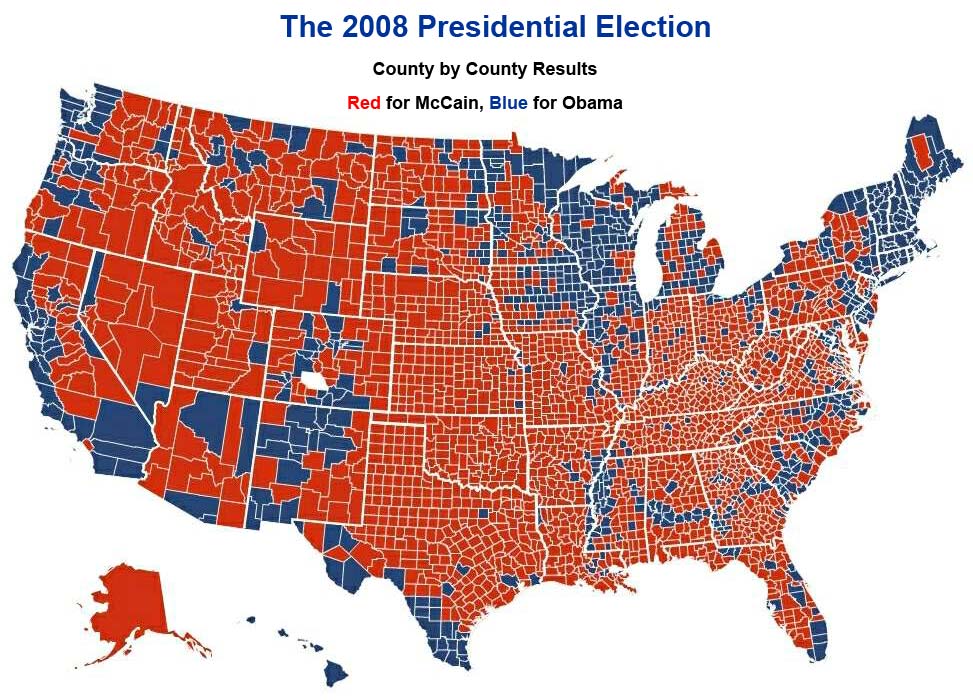
For years we have heard about "red state" vs. "blue state." Red States are suppose to be Republican or Conservative and blue states are suppose to be Democrat or liberal. This trend was recognized by Tim Russert and other news people and there are things to learn from this, but the big message is that it isn't so much "Republican" or "Democrat" as it is "rural" and "urban."


At the end of a Presidential election, the states are defined as large blocks of red and blue based on the winner of the party, but don't give an accurate picture of how it actually looks demographically. A county by county overview is far more helpful.

For example, when you look at this map, you see that there are huge territories that voted Republican (red) and large pockets of blue (Democrat). Those pockets are virtually always in the urban areas. This is not without exceptions (especially in 2008), where entire states voted predominantly Democrat, (see, in particular, New England states), but the rule largely holds true.

Democrats who were elected to the US House and Senate in "red" areas are finding life rather difficult, according to Politico.com. In fact, many of these Democrats are organizing a rebellion against an Administration and Congressional leadership that seems to have a dim view of anything but the needs of urban areas.

The Politico reports: "Angered by White House decisions on everything from greenhouse gases to car dealerships, congressional Democrats from rural districts are threatening to revolt against parts of President Barack Obama’s ambitious first-year agenda."

“'They don’t get rural America,' said Rep. Dennis Cardoza, a Democrat who represents California’s agriculture-rich Central Valley. 'They form their views of the world in large cities.'
Cardoza’s critique was aimed at Obama’s Environmental Protection Agency, but it echoes complaints rural-district Democrats have about a number of Obama administration decisions."
A great example is the demise of auto dealerships, which are not only an important job creator, but a support for community organizations. Little league teams, parks, and parades are often branded with the local car dealers name and when they disappear the towns themselves begin to fade away.

Politico notes: “'In rural jurisdictions, your dealerships are pretty big employers. If you knock out four dealerships, the ripple effects of that are substantial,' said Rep. Frank Kratovil (D-Md.), who represents a largely rural Eastern Shore district and is co-sponsoring a bill that could force the auto companies to honor their contracts with the rejected dealerships."

Furthermore, "Sen. Kay Hagan (D-N.C.) questioned how independent owned and operated businesses have any financial impact on automakers. 'None of us can quite understand why they consider dealerships a drag when they are the ones that buy the cars, that take the financial risks. Many of the dealerships that are being closed are profitable.'”

The Democratic leadership seems to be banking on the idea that they can win without the rural areas, failing to learn the lessons from George Bush in 2004. This is also why you hear the Democrats want to see the end of the Electoral College. Without that element in our political process, rural voters would not have a voice (because Democrats spending all of their money in the ten largest cities in ads would obliterate a GOP challenge). This is why those who created this republic wanted an Electoral College and why they want two Houses of Congress (so small states would have an equal voice). The Founding Fathers understood the need of representing minorities long before the "diversity" crowd.

Kevin Price is Host of the Price of Business, the longest running show on AM 650 (M-F at 11 am) in Houston, Texas and on AOL Radio. His articles often appear in Chicago Sun Times, Reuters, USA Today, and other national media. Steve Moore of the Wall Street Journal calls Price the “best business talk show host in the country.” Find out why and visit his blog at www.BizPlusBlog.com and his show site at www.PriceofBusiness.com. You can also find Price on Strategy Room at FoxNews.com.

Labels: , , , , , , , , , , ,

Saturday, April 11, 2009

Three Mistakes the Tea Party Movement must Avoid

The Tea Party movement is a spontaneous, passionate, and in many respects, disorganized effort to restore those principles that made the United States the greatest country in the history of the world. Like many mass movements in its early stages, it is poised to rewrite the future of this Republic, or to be a mere footnote in US history. Decisions this movement is making today, will have everything to do with its legacy tomorrow.

Currently, there is plenty discussion about what the Tea Party should do. I want to focus on three things it needs to avoid.
  • The Tea Party must never become partisan. Fewer people identify themselves with a party now than at any time in US history. The reason why is because the major parties have failed us miserably. The Reagan Revolution wasn't about partisan politics, but important principles regarding the way government viewed the economy, family, and national security. The 1994 "Contract with America" movement was actually motivated over issues of accountability. You had check kiting Members of Congress who wrote bad checks without consequences and a Post office Scandal (Members would turn their huge allocation of stamps into cash and even included drug laundering) that brought down many Democrats, including the Chairman of the powerful House Ways and Means Committee (Dan Rostenkowski). The current Tea Party is also about accountability, which is very similar to the 1994 elections and needs to maintain that nonpartisan appeal.

  • The Tea Party must not become a single issue movement. On the one hand, Americans have every right to make this movement about taxation. The US has the second highest tax rates on businesses than any industrialized country in the world and the pressure on taxpayers in general are only growing. But there is a widespread attack on America's freedom that include excessive regulations, pressure from organized labor that is poised to damage the US competitive advantage, the disenfranchisement of our political freedoms (thanks to Obama's political antics, e.g., the movement of the Census Bureau to the White House in an effort to effect Congressional Districts, the attack on members of Obama's own party who won't vote lock step with the Administration, etc.), and more. If the movement only worries about taxes, it will be separating itself from those concerned about other issues and validating those who believe that people in this movement only care about money. It isn't about money nearly as much as it is about freedom. That includes economic freedom.

  • The Tea Party must not become about personalities. Right now there is jockeying in the movement all over the country by individuals who want to lead it going forward. If a single individual rises to fill the role, the movement will likely be in trouble. That person will probably have a partisan history that will make him or her easy to dismiss by the movement's opponents. I'm reminded of the early days of the Reagan Revolution, which was led by people who were "mad as hell," like Eddie Chiles in Texas and Howard Jarvis in California. These were individuals who were leaders in business, not politics, and had no further agenda then restoring America's freedoms. In spite of how powerful of a personality Reagan had, he was, in many respects, the epitome of the movement that elected him, rather than the creator of it.

There are, I am sure, other pitfalls the Tea Party should avoid, but by being ever diligent on these three important areas, the Tea Party will be a force to be reckoned with for years to come and should leave a positive and powerful impact on the future of this country.

Kevin Price is Host of the Price of Business, the longest running show on CNN 650 (M-F at 11 am), AOL Radio, and CBS Radio. Eric Bolling of Fox News and Fox Business says that Price’s Blog “is very influential and moves the blogosphere.” Steve Moore of the Wall Street Journal calls Price the “best business talk show host in the country.” Find out why and visit his blog at www.BizPlusBlog.com and his show site at www.PriceofBusiness.com.

Labels: , , , , , , ,