m

Monday, December 07, 2009

The Popular Disdain for the Constitution

At one of her recent press conferences, Speaker Nancy Pelosi's was asked by a CNS News reporter, "Madam Speaker, where specifically does the Constitution grant Congress the authority to enact an individual health insurance mandate?" the Speaker was clearly agitated by the question and responded, "Are you serious? Are you serious?" The reporter said, "Yes, yes, I am." Without commenting further, Pelosi shook her head in disgust and took a question from another reporter. Later on, the Speaker's press spokesman Nadeam Elshami told CNSNews.com about its question regarding the constitutionality of socialized medicine that "You can put this on the record. That is not a serious question. That is not a serious question."

Like every member of Congress, Pelosi takes this sacred oath: "I do solemnly swear (or affirm) that I will support and defend the Constitution of the United States against all enemies, foreign and domestic; that I will bear true faith and allegiance to the same; that I take this obligation freely, without any mental reservation or purpose of evasion; and that I will well and faithfully discharge the duties of the office on which I am about to enter: So help me God." She swears to defend the Constitution, but does not take this question seriously? The arrogance or ignorance is amazing. The question is legitimate, Article I, Section 8 of the Constitution lists the enumerated powers of Congress and there is no provision for health care. Furthermore, the Tenth
Amendment makes it explicitly clear that the powers not listed in the Constitution are to be left to the states and the citizens.

For decades government has gone well beyond it Constitutional responsibility and has become more cavalier about the role of government. Essentially our government is on auto-pilot and simply picks up new duties as it deems fit.

I have said often on my radio show that to be for the Constitution is simply not "cool" and you will not be taken serious in Washington. I have had friends -- both Democrat and Republican -- smugly smile at me and say that arguments about the Constitution are laughable. Discussions about a "strict constructionist" view can only be academic.

I must ask the question, by what standard than are we going to judge government? If not the Constitution, what will be our measure of whether government is serving us properly? It cannot be popular opinion, because the masses can be convinced to believe anything. That is why the Founding Fathers put such safe guards against pure democracy.

This is why I have grown frustrated by the "liberal" versus "conservative" debate. All these two views argue is the pace towards socialism. Liberals ask why we are not fully under government control while conservatives want to argue to slow down the pace. What is there to "conserve" any more? Massive deficits and debts? Taxation out of control? A regulatory system that is hostile to freedom? If we are serious about the Constitution we should drop the conservative label and state we wish to restore the Constitution.

Until we have a serious debate about the Constitution we can only expect our freedoms to further disappear while are political leaders show extreme joy on the left or slight discomfort on the right. The leaders in Washington believe there is nothing government cannot do and they intend to only prove that in the years to come.

Economist Walter Williams recently noted that "in each new session of Congress since 1995, John Shadegg, (R-Ariz.,) has introduced the Enumerated Powers Act, a measure 'To require Congress to specify the source of authority under the United States Constitution for the enactment of laws, and for other purposes.' The highest number of co-sponsors it has ever had in the House of Representatives is 54 and it has never had co-sponsors in the Senate until this year, when 22 senators signed up. The fact that less than 15 percent of the Congress supports such a measure demonstrates the kind of contempt our elected representatives have for the rules of the game -- our Constitution."

How has your member of Congress stood on this important first step in restoring Constitutional government? Instead of arguing with politicians on specific policies, let us make them defend their view of the document they swore to defend .

Kevin Price is a syndicated columnist whose articles frequently appear at ChicagoSunTimes.com, Reuters.com, USAToday.com, and other national media. Kevin Price is Host of the Price of Business (M-F at 11 AM on CNN 650) and Publisher of the Houston Business Review. Hear the show live and online at PriceofBusiness.com. Visit the archive of past shows here.

Labels: , , ,

Tuesday, October 06, 2009

Dancing with Democracy

Recently I was reading Glenn Beck's Common Sense and found it an excellent read. The book is full of sound reasoning as he made a case for liberty and limited government. In it, however, he discusses the virtues of democracy and how that force will restore our government.

Rush Limbaugh, the conservative radio host who saved the AM dial and made that radio band the hot property it is today has a section of his website and a recurring feature on his program in which he refers to himself as "The Doctor of Democracy."

The late Jack Kemp wrote in his excellent book, An American Renaissance that "bad mouthing democracy" was becoming an occupational hazard of Republicans and that they should embrace that form of government rather than distance them from it. The book was excellent, but like all other things I have read and enjoyed, I certainly do not agree with everything in it. Democracy is an extreme form of government that inevitably we lead to totalitarianism. The US has democratic institutions that are checked by the restraints of republican form of government. In these confusing times, "democrat" and "republican" have nothing to do with parties, but philosophies in this article.

The Founders warned of the excesses of democracy and spoke passionately about limited government:

John Adams: "Remember, democracy never lasts long. It soon wastes, exhausts, and murders itself."

Benjamin Franklin: "Democracy is two wolves and a lamb voting on what to have for lunch. Liberty is a well-armed lamb contesting the vote!"

Fisher Aimes: "The known propensity of a democracy is to licentiousness which the ambitious call, and ignorant believe to be liberty."

Even Thomas Jefferson, considered by most of his contemporaries to be the most sympathetic of democracy, was quoted as saying: “A democracy is nothing more than mob rule, where fifty-one percent of the people may take away the rights of the other forty-nine.”

When I traveled to Eastern Europe and the former Soviet Union following the fall of Communism, there were often protests because the people were seeking a quicker pace of reforms. You would find signs, in English to get the message to the United States via TV, that would say "Democracy equals Freedom" and similar themes. Ironically, the first free elections in Germany’s history were in 1932 and led to the rise of Adolph Hitler, whose party enjoyed a mandate. Democracy leads to mob rule and mobs behave in a most destructive fashion riddled with socialism and financial ruin.

We need writers, radio hosts, TV personalities and more to discuss the virtues of republican government, which is found in rule by law. Government should only do those things the people cannot do for themselves. It must be based on law and confined, in our country’s place, to the 17 powers listed in the Constitution. This is why I say that the term "conservative" is a misnomer. There is little liberty left to conserve. The proper term is restore. We must restore liberty, limited government, private property, and free market economics. It needs to become "cool" again to point out the virtues of republican government and to dismiss and to discredit the extremes of pure democracy.

Kevin Price is Host of the Price of Business, the longest running show on AM 650 (M-F at 11 am) in Houston, Texas and on AOL Radio. His articles often appear in Chicago Sun Times, Reuters, USA Today, and other national media. Steve Moore of the Wall Street Journal calls Price the “best business talk show host in the country.” Find out why and visit his blog at www.BizPlusBlog.com and his show site at www.PriceofBusiness.com. You can also find Price on Strategy Room at FoxNews.com.

Labels: , , , , ,

Tuesday, July 28, 2009

What the Government Can and Cannot Do

For the first time in decades there seems to be a serious discussion about the role of government in a free society and the question of what it "can" and "cannot" do is becoming ever so common. Rep. Michele Bachman (R-MN) had an excellent exchange with the Secretary of Treasury Tim Geithner on this subject.

The issue being discussed was the Constitutionality of the bailout. Geithner was being questioned by the House Banking Committee. The exchange went something like this:

BACHMAN: By what authority did the Treasury Department bailout major financial institutions?

GEITHNER (clearly looking puzzled by the question): What do you mean?

BACHMAN: What legal authority did you have to do this?

GEITHNER (almost looking guilty and certainly more confused): Congress said we could.

BACHMAN: What authority did Congress have to do this?

From there the conversation digressed to one very similar that a child with his hand stuck in a cookie jar would say to a parent. "Bobby said I could do it." Of course, Bobby didn't have the authority, but we will blame him anyway. That is the dilemma today. We have years of Constitutional authority that has deteriorated away and a government that largely runs on autopilot. This is beyond government based on "precedent," which means new laws are tested against others that passed court muster. This is filled with enough peril, but the new model is to rapidly pass laws and see if they hold up or not. With so many years of complacency, many things become law that would not have had a prayer a few generations ago.

So the question of what government can and cannot do remains. The answer to me seems simple. You have to read the source, which is the US Constitution. It is a very short read, measured in dozens of pages. The document is also very straight forward:


  • What the Government can do is found in a short section of the Constitution often referred to as the enumerated powers (Article I, Section 8). There you will find seventeen things the government can do. Really interesting things like post offices, post roads, and standard weights and measures. Very little of what government does today can be found as a listed power of government.

  • Many through out the states that were needed in ratifying this Constitution noted a "necessary and proper clause" in Article I, Section 8 that was designed to make sure these 17 things would be allowed to be fulfilled (noting the problems the government had under the Articles of Confederation before). Because of their concerns about the fact that some could interpret that clause as anything those in government deemed "necessary and proper," they forced the government to add Ten Amendments to the Constitution, also referred to as the Bill of Rights.

  • "Amendments", as the name implies is about changing. So these amendments changed any assumptions or potential loopholes in the Constitution in the areas they addressed. When it comes to the issue of government power, the Tenth is the most important of these amendments, stating that "The powers not delegated to the United States by the Constitution, nor prohibited by it to the States, are reserved to the States respectively, or to the people." Simply put, if not an enumerated power, it is for the states or the people. Period. If people want socialized health care, move to states like Oregon or Massachusetts that have such programs or even try to pursue such in their own states. The Founding Fathers were brilliant in understanding that a "one sized fits all" form of government would eliminate competition in policy and have people with no freedom of choice. That, more than anything else, made them believe in state rights.

In spite of the clarity, government has been moving towards the elimination of our freedoms for generations. To move back in that direction will be challenging, but is necessary. What our government is allowed to do according to the law, however, is obvious. To think differently is disingenuous.

Kevin Price is Host of the Price of Business, the longest running show on AM 650 (M-F at 11 am) in Houston, Texas and on AOL Radio. His articles often appear in Chicago Sun Times, Reuters, USA Today, and other national media. Steve Moore of the Wall Street Journal calls Price the “best business talk show host in the country.” Find out why and visit his blog at www.BizPlusBlog.com and his show site at www.PriceofBusiness.com. You can also find Price on Strategy Room at FoxNews.com.

Labels: , , , , , ,

Friday, May 15, 2009

Politicians use Wrong Benchmark in Decision Making


After their designated election cycles members of the US House of Representatives and Senate, as well as the President of the United States, swear to defend the US Constitution. In the vast majority of cases, it appears they are lying.

Unfortunately, most Americans haven't read the half a dozen pages that make up that lean, but important, document. They haven't noticed Article I, Section 8 of the Constitution that limits Congress to around 20 powers. Real exciting things like post offices, standard weights and measures, and post roads.
Very few members care about these mandates and to support them as the scope of government makes them seem little more than eccentric (or worse) in the eyes of their colleagues. It simply isn't trendy to support the law you swear you will defend. When I think of such, I consider my own US Senators, John Cornyn and Kay Bailey Hutchinson, both of whom are Republicans. One of them, Cornyn, is consistently ranked in the top 10 percent of the most conservative by groups that rate voting records. I don't consider this a badge of honor, but an indictment of how liberal Republicans and the Senate have become.

John Cornyn, for example, is among the many who voted for TARP in 2008. Instead of being a true leader and representing his constituents, he chose to be a cheerleader and tried to win support from the GOP leadership. The bill he voted for began in the US Senate (unconstitutional according to Article I., Section 7, which states that "All bills for raising Revenue shall originate in the House of Representatives; but the Senate may propose or concur with Amendments as on other Bills." TARP included provisions for raising revenue. Where it started was grounds for being unconstitutional. I won't even begin to list the many other areas that it fails to uphold the Constitution.

Many who brand themselves as "conservative" use their colleagues with very liberal agendas as the benchmark their philosophy. The reality is, it simply means they are willing to take their time as they stroll down the road to serfdom. I believe the American people prefer those who are honest about their agendas (liberals) than those who are dishonest (so-called conservatives). The last election seemed to prove that true.

The only way to solve this problem is to set a different standard for our elected officials. It is time to select politicians who are strict constructionists when it comes to the Constitution. People who have sworn to defend it and a voting record that reflects that they have done jsut that. Many call themselves "strict constructionists," even George W. Bush who paved the way to much of the socialism the US is now pursuing at a breakneck pace. That is where seriously examining one's political record matters. Instead of "conservatives," I'm looking for candidates who describe themselves as "restorationists" (of the Constitution), and can back it up with their actions.

Holding politicians to the Constitutional standard will lead to more honest government, less government, and the restoration of America's greatness. This won't happen over night and we will receive lectures about "practicality" and being "realistic." Making those concerns our primary drivers, which has been the case for decades, has squarely put us in the mess we are in today.


Kevin Price is Host of the Price of Business, the longest running show on AM 650 (M-F at 11 am) in Houston, Texas and on AOL Radio. Eric Bolling of Fox News and Fox Business says that Price’s Blog “is very influential and moves the blogosphere.” Steve Moore of the Wall Street Journal calls Price the “best business talk show host in the country.” Find out why and visit his blog at www.BizPlusBlog.com and his show site at www.PriceofBusiness.com. You can also find Price on Strategy Room at FoxNews.com.

Labels: , , , , , , , ,

Wednesday, April 01, 2009

"I Believe in Free Enterprise, Except..."

For almost two decades I have been sitting across the table from politicians, authors, business leaders, and economists as guests on one of my radio programs. There have been the occasional crazies who want to socialize everything, but the vast majority of them -- like the majority of your neighbors and co-workers -- claim to support free enterprise.

These conversations about the virtues of the market go the same way. "The free market is so amazing and powerful, it is able to create jobs and new industries. It is terrible that government seems to do everything in its power to undermine the economy's potential." However, you dig a little deeper and then you start finding exceptions. Most of the time those exceptions are based on what they do for a living. Attorneys who represent clients who have suffered property damage will say, "they support free enterprise, except when it comes to the regulations they place on insurance companies." The farmer will tell you, "I definitely support free enterprise, except when it comes to agriculture subsidies." Scientists definitely believe the economy is best left alone "except when it comes to research grants." You get the idea.

Our entire socialistic system has evolved over the decades to accommodate exceptions like these above. Now we have millions of Americans who support free enterprise, "except." That "except" is bankrupting us and destroying our freedoms.

One of the most inspiring things I ever witnessed was the "Damn Right" campaign for President of Pete dupont in 1988. In that year, I actually voted for the former Delaware Governor while managing a Congressional race in West Texas. I have the feeling I was the only one who casted that vote in that town. He lost big time in the ballot box, but his message is as potent today as it was then. Pete duPont had no problem telling farmers, seniors, scientists and anyone else that they were part of the problem and that everyone would have to sacrifice in order to restore our freedoms. It was "damn right" for people to carry their own weight and not seek government as a solution.

Those who founded this Republic were aware that it was the tendency of government to expand over time. That is why they believed in the dispersion of power and they wanted to make changes in policy hard to achieve. The states would not ratify the Constitution with its "necessary and proper clause" that could be used for all form of abuses, without a Tenth Amendment that makes it perfectly clear that "The powers not delegated to the United States by the Constitution, nor prohibited by it to the States, are reserved to the States respectively, or to the people." They envisioned a nation of nations, with each state offering their own unique approaches to solving problems, all of them checked in their excesses because people could leave that state to another that provided more freedom. The decline in our liberties and the increase in socialism, are all linked to the undermining of the political institutions in government designed to protect us from an authoritarian federal government.

So, where does the long path towards the restoration of freedom begin? John F. Kennedy is famous for saying "Ask not what your country can do for you - ask what you can do for your country." We need to ask ourselves, what "exception to freedom can I give up for my country?"

Kevin Price is Host of the Price of Business, the longest running show on CNN 650 (M-F at 11 am), AOL Radio, and CBS Radio. Eric Bolling of Fox News and Fox Business says that Price’s Blog “is very influential and moves the blogosphere.” Steve Moore of the Wall Street Journal calls Price the “best business talk show host in the country.” Find out why and visit his blog at www.BizPlusBlog.com and his show site at www.PriceofBusiness.com.

Labels: , , , , , , ,

Thursday, March 26, 2009

It is a "Restoration" and not "Conservative" Movement

For years I have felt that the term "conservative" was inadequate in describing the objectives of those who support the cause of liberty. The word implies being resistant to change. In fact, Obama and the mainstream media effectively promoted the idea that to be conservative was to want to defend the status quo. Obama's campaign was one of "change" and the media lumped everyone who opposed him as conservatives who wanted to keep things the way they were. This could not be further from the truth.

The term "conservative" doesn't fit those who support freedom today. We do not want to conserve a massive national debt, political elitism, or a deterioration of American families. We are interested in restoring those principles that made American the greatest nation on the face of the earth. Those principles include:
  • The belief in rule of law. Our political system was designed to protect its people from radical change. It was fearful of unchecked mob rule as much as it was an oligarchy and is intended to protect the minority from the majority. Furthermore, it is one of the most difficult constitutions in the world for facilitating change for a purpose. The founders believed that most solutions were found outside of the government and they made a document that promoted such an objective.

  • A commitment to limited government. This nation was founded on the notion of the dispersion of power. The states were significantly more powerful than the federal government and the US Senate (which had its entire membership chosen by governors and state legislatures until the 20th century) was designed for the purpose of protecting those states from the national government. They were originally chosen by state governments as a protector of state rights. The US Constitution provides around 18 powers for the US Congress according to Article I, Section 8. According to the 10th Amendment, everything else was to be left to the states and the citizens.

  • The importance of national security. When our nation was founded the world was much larger. With nuclear missiles only minutes away, we cannot merely be "fortress America," but we also cannot be the world's police force. However, national defense isn't just soldiers and missiles, but national sovereignty is reflected in secure borders.

  • A strong belief in private property. Today, both parties see the building of a shopping mall as a case for "imminent domain" and they regulate people out of their homes in the name of wetlands and endangered species. Our nation was founded on the fundamental importance of the right to property. Furthermore, our political system is opposed to the idea of redistribution of wealth. One of the greatest speeches delivered by any member of Congress was by Davy Crockett, who warned his colleagues about appropriating money for a person in a manner that was not constitutional (the widow of an Admiral). He offered his own salary for a week to help her if his colleagues would join him, and if they did, the sum to be given would be higher that the appropriation. That bill to provide aid was destined to be approved until Crockett took them to task. They voted against the bill, but also kept their week's pay. Crockett got back on the House floor after the vote and noted "You remember that I proposed to give a week's pay. There are in that House many very wealthy men - men who think nothing of spending a week's pay, or a dozen of them, for a dinner or a wine party when they have something to accomplish by it. Some of those same men made beautiful speeches upon the great debt of gratitude which the country owed the deceased--a debt which could not be paid by money--and the insignificance and worthlessness of money, particularly so insignificant a sum as $10,000, when weighed against the honor of the nation. Yet not one of them responded to my proposition. Money with them is nothing but trash when it is to come out of the people. But it is the one great thing for which most of them are striving, and many of them sacrifice honor, integrity, and justice to obtain it."

  • A belief in free enterprise. Government limited its role in the economy to that of a referee and was not to be intrusive. This is seen in it being responsible for such things as "standard weights and measures" and its explicit prohibition in taxing individuals directly (or income tax, which was later changed to all of our demise). Today the government uses taxation, regulation, and licensure laws to keep free enterprise in check, when it should do everything in its power to unleash it. Chief Justice John Marshall noted that the "power to tax is the power to destroy." In recent years, that seems to become the primary mission of government.

Obviously these points only scratch the surface. The point is, those who support the restoration of America's values should use that term and recognize that words like "conservative" fall on deaf ears for good reasons. No one wants to conserve the status quo.

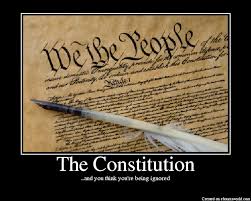
The above image links to an audio of the writer discussing the US Constitution on the Price of Business Show.

Kevin Price is Host of the Price of Business, the longest running show on CNN 650 (M-F at 11 am). Eric Bolling of Fox News and Fox Business says that Price’s Blog “is very influential and moves the blogosphere.” Steve Moore of the Wall Street Journal calls Price the “best business talk show host in the country.” Find out why and visit his blog at www.BizPlusBlog.com and his show site at www.PriceofBusiness.com.

Labels: , , ,